Showing posts with label Tower Hill. Show all posts

Friday, 14 March 2014

Vauxhall Bridge

The inspirations for the Things You See At Lunch tours are sometimes things I’ve just noticed accidentally on my daily traipses around London, sometimes they are things that I’ve always wanted to see and sometimes they are things I come across on TV or writings which have then piqued my interest and require some further investigation.

Today’s entry was inspired by something I read in that very fine free newspaper, loved by all commuters, The Metro, in which they featured an interview with Sandi Tioksvig where she described some of her favourite places in London. One of the places she mentioned was Vauxhall Bridge and the fact that this very functional piece of the London transport system features 8 huge statues of women along each side. The women, interestingly sculptured by two separate artists, are supposed to represent; Agriculture, Architecture, Engineering, Pottery, Science, Fine Arts, Local Government and Education. 7 of those subjects are reoccurring themes in many works of art but I was interested to see how that exciting and dynamic subject of Local Government was going to be depicted. There’s was only going to be one way to find out………

Vauxhall Bridge - Looking downstream.

Regular readers will know that I work on the north bank of Tower Bridge and those with a passing knowledge of London geography will know that this is way downstream whilst Vauxhall Bridge is quite a way away in the other direction to the west.

The tube journey was simple but rather lengthy. The only exciting thing about the District Line train from Tower Hill to Victoria was the fact I squeezed through the closing door of a train leaving platform 2, which is the middle platform used for a regulating service that doesn’t travel any further east. Hardly the joke of the century but it always amusing to see tourists hurriedly stumbling down the stairs when they realise there’s a train waiting on the platform only to find it’s not leaving for 15 minutes and they’ve now missed the service on platform 1.

The change at Victoria was easy enough without too much of a hike underground between lines and it was then only two stops on the Victoria Line to take me south to Vauxhall station. Interesting point to note on the Victoria Line is the tiled motifs which are used to identify the stations. Vauxhall, where I left the train has an impression of the Old Vauxhall Pleasure Gardens.

Nice tiles!

Emerging into the bright sunshine I found myself on the west bank of the Bridge with the A202 stretching out over the bridge to the north. There were some handy steps to the side which allowed me to access the Riverside Walk and get a good view of the upstream side of the bridge and the 4 magnificent ladies standing guard on this side. Unfortunately although the statues are a sizable, a hefty 2 tonnes each, at this distance it was impossible to make out exactly who was who.

A202 leading over the bridge.
 
Miss Pottery viewed from the Riverside Walk

Passing under the bridge along the Riverside Walk I could get a view of the downstream side of things but again was too far away to get any sense of detail. That said though the bridge is quite brightly coloured and on a nice sunny day like today, stands out quite beautifully.

Vauxhall Bridge - Looking upstream.

Mounting back up to the top of the bridge I started my crossing on the downstream side and was able by a little bit of acrobatical leaning over the side to get a look at the 4 ladies on this side in more detail.


This is what Miss Science, Miss Fine Art, Miss Education and Miss Local Government look out on.
 
Miss Pottery, Miss Engineering, Miss Architecture and Miss Agriculture get this.

The first magnificent creature was Miss Science and although I could only really see her profile the globe she is carrying was quite clear from this angle. Next in line is Miss Fine Art complete with sculptured nude in her hand. Thirdly is Miss Education complete with protective arm around a child and finally, even though I didn’t realise it at the time is Miss Local Government complete with ledger in hand and an outstretched pointing arm. Perhaps she was showing someone the queue for housing benefit or something?


Upon reaching the North bank I cross the road and made by way back to the start of the bridge to view the statues from the upstream side. The first lady from this point of view was Miss Agriculture complete with wheat sheaf in hand and next to her was Miss Architecture and I could just about make out the model of St Paul’s Cathedral which he holds. Apparently this is known as the smallest Cathedral in the country although I would challenge that with the model of Coventry Cathedral being held by the effigy of Huyshe Yeatman-Biggs on his tomb.

View from the north side. MI6 building in the top left.
 
From L-R: Miss Agriculture, Miss Architecture, Miss Engineering, Miss Pottery.

To end off the visit my plan was to stroll up to Pimlico Tube Station and get the tube back from there. This route took me through the lovely little park of Bessborough Gardens complete with tinkling water fountain. At the north exit I could spot the limp flags of the European Union and Lithuania denoting the Lithuanian Embassy across the road.


Pimlico Station is just around the corner and after a quick photo of their tiled walls (yellow spots denoting the modern art of the nearby Tate Britain gallery, it was time to take the tube back to work. All done is just over an hour………..thanks Sandi, it was well worth it.


Links

Wikipedia
Secret Cities
Victoria Line Tiles

Thursday, 20 February 2014

Waterloo and City

I like the London Underground. The names, the connections, the colour-coding of the various lines, the map all appeal to my sense of OCD and for all those who decry its rigid unsociability would surely admit that it’s still a wonderful place for people watching.

My daily Tube route is a fairly basic half loop around the Circle Line from Paddington to Tower Hill, but every once in a while I also mix this up with a quick dive down the Bakerloo Line to Embankment and then a cut across to Tower Hill on the District Line. Variety, as they say, is the spice!

Not even the tourists I seem to bump into every day could get lost on this line.

Even to the casual observer there’s one of the eleven lines which stands out as a little bit special. This is the Waterloo & City line, which with its grand total of two stations is never going to feature on many a tourist’s route map. Never having travelled on this, dare I say, whimsical little line, I thought this would make an ideal episode of Things You See At Lunch.

Those familiar with the Tube layout will quickly realise that from my terminus of Tower Hill I only needed to make the one stop west on the District Line to Monument and then walk through the miles of tunnels to Bank and jump on the targeted turquoise line.

The first job was simply done, delayed only by a sluggish Tube worker who stumbled down the stairs at snail’s pace meaning I missed one tube and had to wait at least all of three minutes for the next one. The route through Monument to the Bank side of this joined station is torturous to say the least. You go down two escalators (stand on the right) along two corridors (walking first on the right then the left) and back up two escalators before taking the “branch” corridor to the Waterloo & City platforms.

Going down the first escalator.

The rather space-age looking corridor to the Waterloo & City Line.

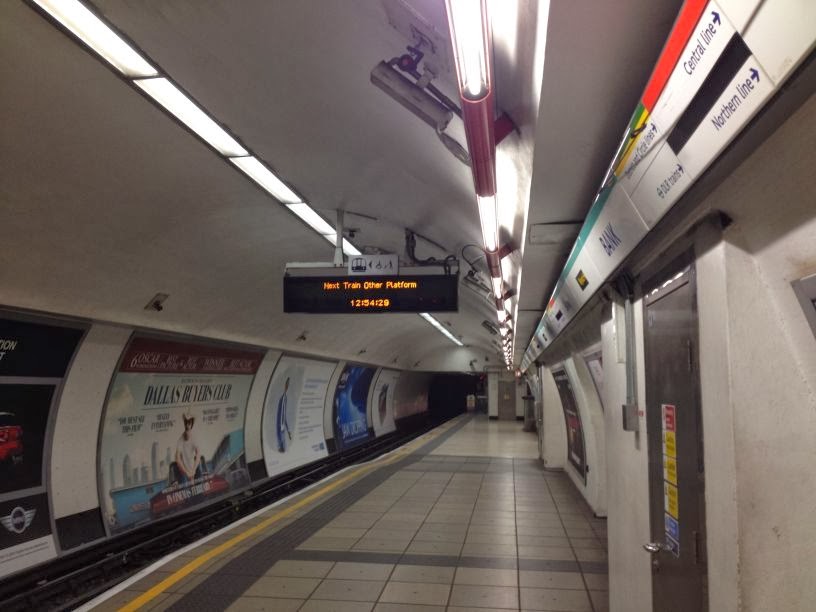
As you would expect, there are still two platforms because although there’s only two stations, it’s not a shuttle service. Taking advice from the sign which told me the next train was coming into the other platform I crossed over and had but to wait a minute or two for the arrival of said train.

Go to the other platform.

Alright I will. The train that took me from Bank to Waterloo.

The trains running on the W&C are only four carriages long, much shorter than the ones serving the other lines, but the actual design of the carriages are the same. I was never the less delighted to see that the bars in the carriage were done in matching turquoise, which is something I think is a must. I’ve still never forgiven the “black” Northern Line for using yellow bars!

Turquoise bars and empty carriages.

I’m guessing the line might be chocca with commuters during rush hours, but on a quiet Tuesday lunchtime there was only a smattering of others in my carriage and the only people watching I could do was the pink boots of the woman opposite.

The view down the tunnel to the depot.

The journey took exactly 4 minutes 14 seconds so before I knew it were had dived 7 metres under the Thames and emerged at Waterloo. At the end of the platform you could take a peek down the rest of the tunnel to the line’s terminus where the trains undergo their repairs and maintenance. One other difference between this line and all the rest is that it’s all totally “underground” and the rolling stock has to be lifted by cane in and out of the line. All the other lines have some part of their route overground, apart from the Victorian Line but even this has its depot overground.

Waterloo Station Clock.

The foot journey into Waterloo station is much quicker at this end and before you could say “nice station clock” I’d walked from my emerging point by Platform 6 and re-entered the underground system by Platform 18.


The platforms at Waterloo work differently to the ones at Bank though, basically from what I can make out, you have an arrivals platform and a departures platform, unlike Bank where you have two platforms both welcoming and dispatching trains.

The "exit" platform at Waterloo.

The train that took me from Waterloo to Bank.

Anyway, this difference acknowledged it was time for the 4 minute journey back in a completely empty carriage, which isn’t very good for people watching at all.

Deciding I didn’t want to traipse back through the corridors and escalators back to Monument I exited through the barriers and took the spectacular 140 metres worth of Travelator back to Bank proper. I then left the station to make my way back overground and promptly got caught in a cloud burst and arrived back at the office dripping!

Travelling the Travelator.

Want some more facts about the Waterloo & City?
  • The line opened in 1898 but was the last line to be incorporated into London Underground from British Rail in 1994
  • Bank station was originally called City, hence the name of the line.
  • The length of the line is 2.37 kms
  • The line has the nickname “The Drain”
Will that do? No? Then do your own reading!

The Bank at City.

Links


Wednesday, 12 February 2014

Golden Galleons

It’s not just me who’s ever said that by wandering around London with your eyes cast downwards, looking at nothing more than trying to avoid pigeons, idiot tourists and chewing gum (in that order) you miss a heck of a lot of stuff that’s going on at eye level or even higher.
I was reminded of that sentiment the other day when at the bottom of the steps to the entrance to Tower Hill tube station I noticed a shining golden galleon weather vane perched atop of rounded cupola.
The cupola is dead centre - there is a weather vane on the top, honest!
Those instant questions of; what? why? where? leapt to mind so I thought a sort of magical mystery tour to see if I could find the source of the rainbow, or in this case, the weather vane and why the building was deemed important enough to have been crowned so.
From the top of the steps with the entrance to the tube just to my left, I could see that the building was in the centre of two streets which run north from my current location; there was The Minories (or the A1211 to its friends) on the right and Trinity Square running into Cooper’s Row on the left.
Skirting round the remains of the roman walls and the children’s play park I walked up The Minories to a junction on the left called The Crescent which curves back up north along a row of very gracious looking terrace houses.

Weather Vane dead centre again, honest!
The weather vane could still be seen just poking over the roof line and just to the end of the houses I could see a small alleyway leading further into the centre of the buildings.


This short alleyway led to another hidden section of roman wall, quite a sizable chunk to be honest, and the path had been modernised around it meaning you could pass through to a very pleasant courtyard with a couple of shops.

 
Somewhat disappointingly this very short magical mystery tour had ended because on the left hand side of the courtyard was the building itself with the weather vane just visible by craning one’s neck vertically.

That Weather Vane again.
It wasn’t all disappointment though as the wall of the building sported an impressive coat of arms and a plaque declaring it to be “City Heritage Award - Presented by the City Heritage Society and the Worshipful Company of Painter-Stainers”. This proved rather a puzzle as some internet investigations showed that the Worshipful Company of Painter-Stainers’ ceremonial hall (Painters’ Hall) is now located quite a distance away in Little Trinity Lane and the coat of arms they have on display here looks nothing like the one I could see in front of me. But there again perhaps the Painter-Stainers were only sponsoring the award and had no relation to the coat of arms on display. Perhaps a puzzle for another time?


My route then took me through the underpass by the Grange Hotel and I was then almost back to where I’d started at the junction of Trinity Gardens and Cooper’s Row.

View back through the hotel car port to the courtyard.
 
But that wasn’t the end of the interesting things.
Firstly there was a “Ward Sign” which can be spotted all around “The City” marking out the various wards of the city – perhaps there’s another tour in its own right to see as many of these as possible? Secondly there was a Blue Plaque which is always nice to stumble across. This one marked the one-time resident of the Reverend P.T.B. "Tubby" Clayton who was a founder of the Toc H, a respite club for soldiers from the Great War established in Belgium. Finally there was another plaque but this one is set in stone and was a memorial to Viscount Wakefield of Hythe who (according to the plaque) “….. with his wife led tower hill restoration and gave this house for good to church and people MCMXXXVII” and was also a good friend of the afore mentioned Rev Clayton.


But of course whilst I’d found the weather vane I was still no further in understanding who owns it or why it was there. The ownership was quickly cleared up as the building is currently occupied by Crawfords & Co, a firm of global insurers, so I can only presume they inherited the building complete with weather vane rather than having installed it themselves.
What I did discover though was that I should perhaps practice what I preach, as whilst I was researching the weather vane, I discovered thanks to the brilliant Secret London website, Trinity House which is on the corner of Trinity Square, almost exactly opposite from Vicount Wakefield’s plaque, also sports another shining galleon style weather vane! And I’d completely missed it! This one’s originals are slightly easier to work out though as Trinity House is the headquarters of “Trinity House” who are the “General Lighthouse Authority for England, Wales, the Channel Islands and Gibraltar” no less.

The Weather Vane on Trinity House.
So mystery not quite solved, but shows that it pays to keep your eyes peeled!
Links: