Thursday, 20 February 2014

Waterloo and City

I like the London Underground. The names, the connections, the colour-coding of the various lines, the map all appeal to my sense of OCD and for all those who decry its rigid unsociability would surely admit that it’s still a wonderful place for people watching.

My daily Tube route is a fairly basic half loop around the Circle Line from Paddington to Tower Hill, but every once in a while I also mix this up with a quick dive down the Bakerloo Line to Embankment and then a cut across to Tower Hill on the District Line. Variety, as they say, is the spice!

Not even the tourists I seem to bump into every day could get lost on this line.

Even to the casual observer there’s one of the eleven lines which stands out as a little bit special. This is the Waterloo & City line, which with its grand total of two stations is never going to feature on many a tourist’s route map. Never having travelled on this, dare I say, whimsical little line, I thought this would make an ideal episode of Things You See At Lunch.

Those familiar with the Tube layout will quickly realise that from my terminus of Tower Hill I only needed to make the one stop west on the District Line to Monument and then walk through the miles of tunnels to Bank and jump on the targeted turquoise line.

The first job was simply done, delayed only by a sluggish Tube worker who stumbled down the stairs at snail’s pace meaning I missed one tube and had to wait at least all of three minutes for the next one. The route through Monument to the Bank side of this joined station is torturous to say the least. You go down two escalators (stand on the right) along two corridors (walking first on the right then the left) and back up two escalators before taking the “branch” corridor to the Waterloo & City platforms.

Going down the first escalator.

The rather space-age looking corridor to the Waterloo & City Line.

As you would expect, there are still two platforms because although there’s only two stations, it’s not a shuttle service. Taking advice from the sign which told me the next train was coming into the other platform I crossed over and had but to wait a minute or two for the arrival of said train.
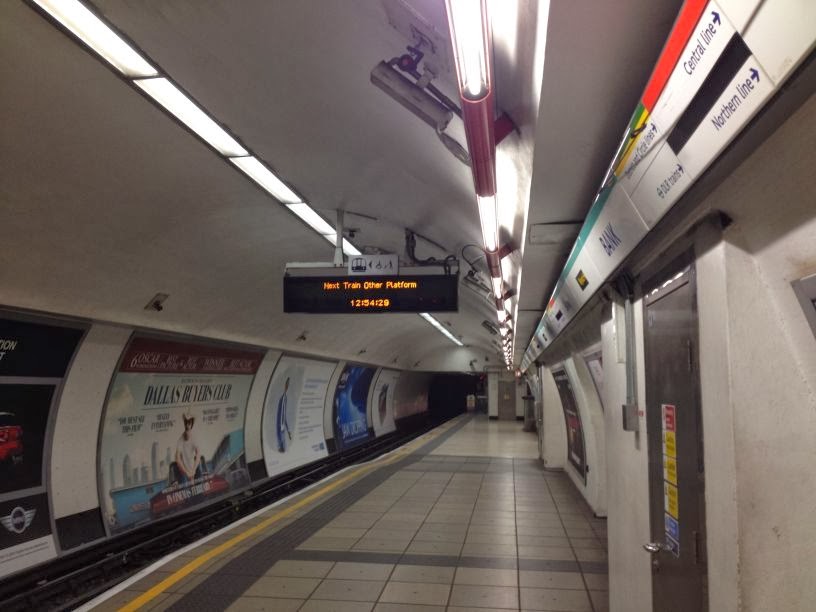
Go to the other platform.

Alright I will. The train that took me from Bank to Waterloo.

The trains running on the W&C are only four carriages long, much shorter than the ones serving the other lines, but the actual design of the carriages are the same. I was never the less delighted to see that the bars in the carriage were done in matching turquoise, which is something I think is a must. I’ve still never forgiven the “black” Northern Line for using yellow bars!

Turquoise bars and empty carriages.

I’m guessing the line might be chocca with commuters during rush hours, but on a quiet Tuesday lunchtime there was only a smattering of others in my carriage and the only people watching I could do was the pink boots of the woman opposite.

The view down the tunnel to the depot.

The journey took exactly 4 minutes 14 seconds so before I knew it were had dived 7 metres under the Thames and emerged at Waterloo. At the end of the platform you could take a peek down the rest of the tunnel to the line’s terminus where the trains undergo their repairs and maintenance. One other difference between this line and all the rest is that it’s all totally “underground” and the rolling stock has to be lifted by cane in and out of the line. All the other lines have some part of their route overground, apart from the Victorian Line but even this has its depot overground.

Waterloo Station Clock.

The foot journey into Waterloo station is much quicker at this end and before you could say “nice station clock” I’d walked from my emerging point by Platform 6 and re-entered the underground system by Platform 18.


The platforms at Waterloo work differently to the ones at Bank though, basically from what I can make out, you have an arrivals platform and a departures platform, unlike Bank where you have two platforms both welcoming and dispatching trains.

The "exit" platform at Waterloo.

The train that took me from Waterloo to Bank.

Anyway, this difference acknowledged it was time for the 4 minute journey back in a completely empty carriage, which isn’t very good for people watching at all.

Deciding I didn’t want to traipse back through the corridors and escalators back to Monument I exited through the barriers and took the spectacular 140 metres worth of Travelator back to Bank proper. I then left the station to make my way back overground and promptly got caught in a cloud burst and arrived back at the office dripping!

Travelling the Travelator.

Want some more facts about the Waterloo & City?
  • The line opened in 1898 but was the last line to be incorporated into London Underground from British Rail in 1994
  • Bank station was originally called City, hence the name of the line.
  • The length of the line is 2.37 kms
  • The line has the nickname “The Drain”
Will that do? No? Then do your own reading!

The Bank at City.

Links


Wednesday, 12 February 2014

Golden Galleons

It’s not just me who’s ever said that by wandering around London with your eyes cast downwards, looking at nothing more than trying to avoid pigeons, idiot tourists and chewing gum (in that order) you miss a heck of a lot of stuff that’s going on at eye level or even higher.
I was reminded of that sentiment the other day when at the bottom of the steps to the entrance to Tower Hill tube station I noticed a shining golden galleon weather vane perched atop of rounded cupola.
The cupola is dead centre - there is a weather vane on the top, honest!
Those instant questions of; what? why? where? leapt to mind so I thought a sort of magical mystery tour to see if I could find the source of the rainbow, or in this case, the weather vane and why the building was deemed important enough to have been crowned so.
From the top of the steps with the entrance to the tube just to my left, I could see that the building was in the centre of two streets which run north from my current location; there was The Minories (or the A1211 to its friends) on the right and Trinity Square running into Cooper’s Row on the left.
Skirting round the remains of the roman walls and the children’s play park I walked up The Minories to a junction on the left called The Crescent which curves back up north along a row of very gracious looking terrace houses.

Weather Vane dead centre again, honest!
The weather vane could still be seen just poking over the roof line and just to the end of the houses I could see a small alleyway leading further into the centre of the buildings.


This short alleyway led to another hidden section of roman wall, quite a sizable chunk to be honest, and the path had been modernised around it meaning you could pass through to a very pleasant courtyard with a couple of shops.

 
Somewhat disappointingly this very short magical mystery tour had ended because on the left hand side of the courtyard was the building itself with the weather vane just visible by craning one’s neck vertically.

That Weather Vane again.
It wasn’t all disappointment though as the wall of the building sported an impressive coat of arms and a plaque declaring it to be “City Heritage Award - Presented by the City Heritage Society and the Worshipful Company of Painter-Stainers”. This proved rather a puzzle as some internet investigations showed that the Worshipful Company of Painter-Stainers’ ceremonial hall (Painters’ Hall) is now located quite a distance away in Little Trinity Lane and the coat of arms they have on display here looks nothing like the one I could see in front of me. But there again perhaps the Painter-Stainers were only sponsoring the award and had no relation to the coat of arms on display. Perhaps a puzzle for another time?


My route then took me through the underpass by the Grange Hotel and I was then almost back to where I’d started at the junction of Trinity Gardens and Cooper’s Row.

View back through the hotel car port to the courtyard.
 
But that wasn’t the end of the interesting things.
Firstly there was a “Ward Sign” which can be spotted all around “The City” marking out the various wards of the city – perhaps there’s another tour in its own right to see as many of these as possible? Secondly there was a Blue Plaque which is always nice to stumble across. This one marked the one-time resident of the Reverend P.T.B. "Tubby" Clayton who was a founder of the Toc H, a respite club for soldiers from the Great War established in Belgium. Finally there was another plaque but this one is set in stone and was a memorial to Viscount Wakefield of Hythe who (according to the plaque) “….. with his wife led tower hill restoration and gave this house for good to church and people MCMXXXVII” and was also a good friend of the afore mentioned Rev Clayton.


But of course whilst I’d found the weather vane I was still no further in understanding who owns it or why it was there. The ownership was quickly cleared up as the building is currently occupied by Crawfords & Co, a firm of global insurers, so I can only presume they inherited the building complete with weather vane rather than having installed it themselves.
What I did discover though was that I should perhaps practice what I preach, as whilst I was researching the weather vane, I discovered thanks to the brilliant Secret London website, Trinity House which is on the corner of Trinity Square, almost exactly opposite from Vicount Wakefield’s plaque, also sports another shining galleon style weather vane! And I’d completely missed it! This one’s originals are slightly easier to work out though as Trinity House is the headquarters of “Trinity House” who are the “General Lighthouse Authority for England, Wales, the Channel Islands and Gibraltar” no less.

The Weather Vane on Trinity House.
So mystery not quite solved, but shows that it pays to keep your eyes peeled!
Links:

Thursday, 23 January 2014

St George in the East

It sometimes seems that whenever the work “church” is mentioned within the hearing of the devout, they are quick to claim that the word means much more than the bricks and mortar of the building but instead encompasses the people, community and work of the establishment as a whole. I can live with that definition but have to state that my preference is for the bricks and mortar over everything else every time.

By and large the churches in this country remain interesting and curious buildings, they often have long and fascinating histories and they are a whole variety of shapes, sizes and styles. I’ve often wondered what would happen nowadays if you tried to get planning permissions to build such a building. Leaving aside the question of where you would get the vast funding necessary for building the place, can you imagine the plans going in front of your average local planning committee? “Oh yes, a 300ft steeple? No problems, are you planning a tower as well?”

A Church - With a Tower.

Nicholas Hawksmoor can be rather disingenuously be described as Britain’s second most well-known architect after Christopher Wren – (but Hawksmoor got a mention in Peep Show, which Wren never did) – and he is responsible for 6 churches dotted around London. One of them is St George in the East located on the junction of Cannon Street Road and the A1203 Highway.

It’s a church that I see very regularly as my twice weekly lunchtime jogging route takes me past it and it’s a pleasant and impressive sight that breaks up the monotonous grey of the traffic that rushes down the busy dual carriageway.  Because my running prowess limits me to a modest 5km it’s somewhere that’s easy to reach for a lunchtime visit.

South Side.

Although the church grounds face right onto the A1203 there’s still an almost eerie sense of calm as you step into the grounds even though there’s nothing but a bit of a hedge and wall separating the two. The south side is blocky and almost functional looking and if it wasn’t for the towers you might think you were outside a museum.


A rather slippery mossy path leads round to the east and the grounds proper which display a much more attractive vista with the curved arch of the nave the focal point.


The path lined with gravestones. All are illegible but still rather gruesome


There’s a row of weathered tombstones lining the path which leads down to one of the most interesting bits of the church, the Nature Study Museum. The former church mortuary was converted in 1904 into a nature study centre and museum, which displayed live exhibits as well as stuffed animals, plants and flowers. The building is now in a very dilapidated state but hopes and plans to restore the building are afoot and one can only hope they come into fruition.

The Nature Study Centre - The name can still be made out above the door.

Leading away from the church in the north-eastern corner is a path that takes you up to Cable Street and deposits you right next to St George’s Town Hall (opposite Shadwell station) where the west wall is decorated with a large colourful mural commemorating the “Battle of Cable Street”.
The potted history of this event was the opposition by local Eastenders to a march through the area by the British Union of Fascists (BUF), led my Oswald Mosley and his Blackshirts in October 1936. The locals, bolstered by Jewish, Irish, socialist and communist groups held back the march under the slogan “They Shall Not Pass” and it’s widely accepted that this event and ones that happened in the aftermath were the catalyst for the decline of the BUF before the Second World War.


My walk took me along the length of Cable Street, back towards the west and on the junction with Dock Street there’s a Red Plaque which commemorates the event.


A final mention for today’s update, is for the 3 pubs which are spottable along the route. On the junction of the A1203 and Chigwell Hill is The Old Rose, which although boarded up still has a row of shiny brass lamps outside. The former Britannia Tavern at 232 Cable Street is now private housing, but the attractive green and yellow tiles are still present on the outside of the building. Finally on the junction of Cannon Street Road and Cable Street is the Crown & Dolphin. Still complete with signage there’s a fantastic story of the skull of a suspected murderer being displayed in the pub for many years. Poor John Williams, the owner of the skull, was the last person in England to be staked through the heart at his funeral in 1812 when he committed suicide whilst arrested for the involvement in the Ratcliff Highway Murders.

The former Britannia Inn


The Crown & Dolphin

Alas all three are currently closed but I hope that even if they don’t return as pubs, suitable uses will be found for these lovely old buildings.

A final postscript is that on my way to the church I passed a building proudly bearing the sign that it is the "Strangers Rest Evangelical Church" – I reckon this is what you’d end up with if you submitted your plans to build a church nowadays........or even a pub maybe.


Links

Wikipedia
St George in the East Site

Friday, 17 January 2014

Giro the Alsatian

If you stumble across a sentence on the internet that reads "Do you know there is only one Nazi grave in London", you can't help but be intrigued, surely.

Well it turns out the truth is slightly less startling than the headlines but never the less this is still a charming and interesting story. In the early 1930's the German Embassy in London was located on Carlton House Terrace in a row of splendid buildings now occupied by the Royal Society. From 1932 to 1936 the ambassador was Dr Leopold von Hoesch, a representative of the Weimar Republic which was then in power in Germany.


Dr Hoesch owned a pet Alsatian called Giro (I presume it's pronounced Jee-ro rather than like an UK unemployment payment (Jai-ro) and the faithful animal got himself killed in 1934 when he chewed through an electric cable during some extension works.

No doubt heart-broken by the loss of his friend, Dr Hoesch had Giro buried under a tree in the garden and the gravestone marking his final resting place is still there today.

The journey to the grave is interesting in its own right. I caught the tube from Tower Hill to Embankment and took the short walk across the south end of Trafalgar Square passing under the splendid Admiralty Arch into The Mall.


You're probably still fighting against the tourists at this point as you've got people strolling down the length of The Mall to Buckingham Palace (just visible at the far end) and other people crossing into St James's Park but only a short distance down the pretty pink road you turn right and walk up the Duke of York steps to the impressive Duke of York Column.


Once you've finished gawping up at the column look down to the left and you'll see a tree behind a iron railing fence and just beneath the tree a very small curved grave stone underneath a rather Heath Robinson looking wooden shelter.

The inscription on the grave reads - "Giro" Ein Treuer Begleiter! London im Februar 1934. Hoesch - and for those whose German is not quite up to it, translates as - "Giro" A True Companion!


Whilst you're in Waterloo Square, it's worth strolling around the various other statues of Generals, Field Marshals and Kings (Edward VII on his horse) but none of these quite captures the small quiet dignity of Giro's final resting place.

It's worth finishing with the fact that when Hoesch died, only 2 years after Giro in 1936, he was afforded full military honours when his body was repatriated. This meant a gun carriage carrying his coffin draped in the Nazi Swastika paraded through the streets of London which has obviously lent weight to the story of the "only Nazi grave in London" - In fact though, Hoesch, it seems, was a liberal minded and fair politician, much liked by the British establishment and someone who challenged Hitler and the rest of the Nazi party on a great many things at this time.

Links:

Black Cab London
Go London
Tired of London Tired of Life
Shady Old Lady

Jacob the Circle Dray Horse

I work at the end of Tower Bridge, on the north bank of the Thames. That's not saying I raise the bridge or anything but that's the start point for these lunchtime excursions.


If you cross Tower Bridge to the south side you reach an area known as Horselydown, and possibly the first building you see is the old Courage Anchor Brewery on the left hand side. No longer in use, for a long long time, this and the other dockside warehouses have been redeveloped into quite a chic and well-heeled maze of streets and alleyways featuring boutique shops and specialist food outlets.


It was whilst wandering around these streets that I stumbled on the statue of Jacob the Circle Dray Horse one day and decided to make revisit him as my first lunchtime sight.


Jacob stands on a tiny little traffic island in the middle of Queen Elizabeth Street and celebrates, according to the inscription, the famous brewery dray horses which used to deliver beer all around London. I'm assuming dray horses weren't just used by the brewery at this time but probably by the whole dockland industry, but quite why Jacob and his fellows need commemorating there's unfortunately fewer details.


The reason I like the statue so much is firstly it's completely unexpected, you literally walk down a normal boring grey concrete street and there in the middle of the road is a huge lump of bronze horse. And it is a big statue, make no mistakes about that! Secondly it one of those statues that does exactly what it says on the tin. You want a statue of a dray horse? Here you are, a statue of a dray horse. It's like when you try to draw something at school, let's say a horse, and it turns out crap but the teacher still says, "ah, but you've captured the essence of the horse in your drawing" as if that should make it ok. "But miss, it looks like a three legged hippo-sheep on crack" you wail, realising perhaps for the first time you're going to have to work for a living and no be able to sketch tourists for cash.


Jacob is set off rather nicely by the apartments that surround him and the blue tiles they've used to clad the buildings. My one complaint is the unnecessary traffic sign which no doubt was sanctioned by some council busybody.


If you want to visit Jacob may I suggest that your route takes you down Maguire Street where you'll pass Thames Water's Shad Thames Pumping Station. I have a strange liking for water stations as they are normally nice symmetrical brick buildings with impressive windows and doors. I would like to live in one, and you can quote me on that. This particular pumping station meets all those criteria and even has the original "London County Council" inscription running along the top.


You can continue down Maguire Street, past the Design Museum to the banks of the Thames where you get a very impressive view of the London skyline, and one that is much less seen by the regular tourists.


There's been some effort to "art-up" this promenade with some massive chain links and what looks to be a decommissioned engine (?) but give me a huge lump of dray horse over that pap any day!


Links (Geddit? Links? See what I did there?):

London Remembers
Tired of London Tired of Life
Secret London

Wednesday, 15 January 2014

Opening the Lunch Box

London is a great place to work. Well I like it anyway and if you can avoid the tourists, the trolley-bags on wheels, the tourists, the traffic, the tourists, the tube strikes, the tourists, the trip hazards and the tourists it's still one of the most fascinating cities in the world.


That said, the problem with slogging through a 9 to 5 every day is that you tend to travel to the office, do your work (a bit) and then travel back from the office. Head down, eyes front and if your journey is also underground, then you can miss the interesting sights and sounds that are all around.


And that's 'cause it's a fact that whilst you might also not be ever more than 6 foot away from a rat in London, you're also probably a shorter distance away from something historic or at the very least interesting.


New Year's resolutions 2014 have decreed that this year (at the very least) I should make a regular attempt to try to leave the office at lunch and "see" something that's slightly more interesting than a computer screen.


The "rules" are simple; the "thing" should be free to visit, be visitable in an hours lunch break, be vaguely interesting and, if possible, be something of a hidden gem.


It would be far far too easy to choose the common tourist attractions, say Trafalgar Square, and walk around this chewing a cheese and tomato baguette, photographing the pigeons and nodding about how interesting this all is. What's far far better is to discover those little things which are little known about and even if they are known about, nobody visits them on their once a year trip to the big smoke.


So dig out your greaseproof paper, pick up a penguin and lick you lips for a more interesting lunch time.